-WebP.webp)


When Threads Heal What Words Cannot: The Quiet Science Behind Embroidery and Emotional Recovery

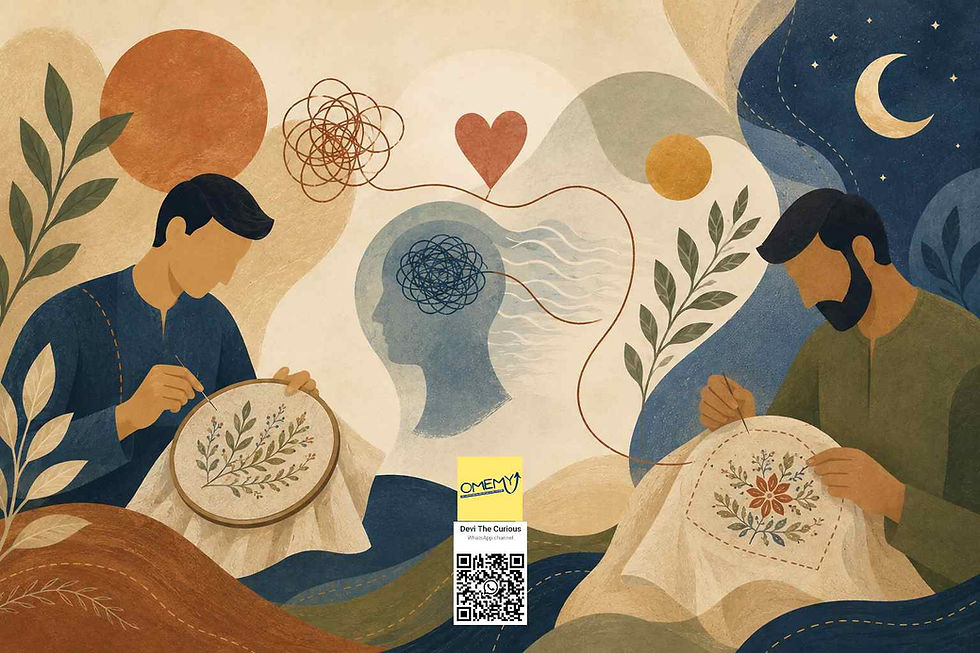
Research shows that slow, repetitive handwork like embroidery can calm a stressed brain and body. It helps lower stress hormones, slows down a racing heart, and quiets the parts of the brain that keep replaying painful memories [1]. This blog tells the story of two real people, Narendrakumar P Dave and John Brown, whose lives were quietly rebuilt stitch by stitch, and asks whether we, as a generation glued to screens, have forgotten one of our oldest tools for healing.
As always, let's start with a story!
Kanika Sachdeva, the promoter of Omemy, didn't set out to write about neuroscience. She set out to document beautiful embroidery. But somewhere between admiring intricate stitches at Hounslow Adult & Community Education and hearing a daughter recall her father's quiet war with memory, she stumbled onto something bigger. Two men, decades and continents apart, had both found their way back to themselves through a needle and thread.
The Man Who Was Never Meant to Fit In
Narendrakumar P Dave was born in Kenya (Nairobi). His childhood was spent in Surendranager (Gujarat in India), in a neighbourhood where women sat on verandahs embroidering colourful motifs on everyday fabric. As a child, Narendra watched them for hours, a strong visual learner who absorbed patterns the way other children absorbed arithmetic. Except arithmetic, and the rest of formal schooling, never quite worked for him. In India and later in Britain, he couldn't align with the rigid structure of normal classrooms. He was eventually sent to a school for special children and never completed a formal education.
Life outside the classroom wasn't gentler. Narendra faced repeated deceptions in his personal relationships, the kind that slowly erode a person's ability to trust anyone around them. Then his mother passed away in 2002, and the loneliness that followed was, in his own words, absolute.
For years, that loneliness sat quietly in the background of his life. Then the world went into lockdown in 2020!
Bored, restless, and with nowhere to direct his restless visual mind, Narendra picked up a needle and tried a few stitches on an old handkerchief. What came out surprised even him. Relying entirely on childhood memory, the same motifs he'd watched neighbourhood women stitch decades earlier, he produced a beautiful, competent pattern on his very first attempt. Something in him recognised the moment for what it was.
Today, Narendra spends four to six hours a day embroidering. He has become a self-taught craftsman who travels to India specifically to source fabric pre-printed with embroidery motifs, bringing back piles of it to work through at home. He says the hours he spends bent over a hoop make him forget the ugliest episodes of his life. He plans to decorate his entire home with his own embroidered work, turning what was once a coping mechanism into a lasting legacy.
There's a reason this isn't a coincidence. Scientists say our brain has three teams that work together. One team helps us relax and think about ourselves calmly. Another team acts like an alarm, watching out for danger. The third team helps us focus and finish tasks, almost like a class monitor keeping everyone in order. When someone has been through something painful, the "relax" team goes quiet and the "alarm" team gets stuck switched on, so the person feels anxious all the time. Doing something slow and repetitive, like following a stitch pattern again and again, wakes up the "focus" team. That team then calms the alarm down and helps the "relax" team switch back on [1]. Narendra didn't need a scientist to explain this to him. His hands found the answer years before research caught up to explain why it worked.
Narendra Dave working on his next embroidery project Narendra Dave working on his next embroidery project Kanika, Narendra & Anita with Narendra's work Narendra's hand embroidered masterpiece Next project lined up for Narendra New needlework-almost completed-Narendra P. Dave Narendra's embroidery work
The Soldier Who Came Home a Stranger, and the Life He Rebuilt
The second story Kanika encountered was quieter, and older.
John Brown served with the British medical corps during the Second World War, posted in Singapore when his entire unit was captured by the Japanese army. He was moved to Thailand along with thousands of others and forced to work as a prisoner of war on the Burma Railway (nicknamed as 'death railway' because of the sheer number of people who died in this project), one of the most brutal forced labour projects in modern military history. He endured those conditions for years before he was finally released when the war ended in 1945. For his bravery during the war, John was awarded several medals, a quiet reminder that the same man who suffered so much also showed remarkable courage.
John was among the fortunate few who survived and made it home. But survival and healing are not the same thing. When he returned, he met his daughter Christine for the first time. She was already four years old. The brutalities he had lived through as a POW never fully left him. Christine, now in her eighties, still remembers her father going through periods that were difficult for the whole family, the kind of rough patches families rarely talk about openly but never forget either.
Eventually, John's GP referred him to therapy. It was in the course of those sessions that he began embroidering table covers, intricate, patient, unhurried pieces that took considerable time and concentration to complete. They remain a quiet testimony to a man working through unspeakable memory, one stitch at a time.
What followed was, in many ways, a full and settled life. After therapy, John went on to work at the post office, building a steady routine and a sense of purpose in the years that followed. He went on to raise his family with care, and today he is remembered fondly, not for the war he survived, but for the grandfather and great-grandfather he became. John passed way in 2009, well in his 90s. His children, grandchildren, and great-grandchildren still speak of him with warmth, a man who came home broken in ways that couldn't always be seen, and who slowly, patiently, stitched himself back together. In fact, the story here has been facilitated by Christine’s daughter-in-law Cheryl, who proudly displayed John’s embroidery work, medals, and stories describing her husband’s grandfather as a man of steel as well as a loving grandfather.
John's experience mirrors what history has recorded about soldiers before him. During the First World War, injured and shell-shocked soldiers were taught embroidery in hospitals, then simply called "fancy work," to help retrain their shaking hands and calm their troubled minds [2] [5]. Therapists and craft researchers often draw a fascinating parallel: the side-to-side movement of a needle going in and out of fabric looks a lot like a well-known trauma treatment called EMDR, where a therapist gets a patient to move their eyes from side to side while thinking about a painful memory. In both cases, the back-and-forth movement seems to help the brain file away a scary memory as something that is over, instead of something still happening right now [3]. John's needle, moving steadily back and forth across fabric decades after the war ended, was doing exactly that.
John Brown's medals Table Cover embroidred by John Brown during therapy John Brown's medals Table Cover embroidred by John Brown during therapy Table Cover embroidred by John Brown during therapy John Brown's medals Backside of the embroidery piece, done to perfection John Brown in his later years John Brown: A young soldier
What the Fabric Remembers
Neither Narendra nor John set out to make a statement. But their embroidered pieces, when you look closely, share something in common: they are large, intricate, use a variety of stitches and clearly unhurried. Every new stitch learnt to complete the motifs would have been a new challenge, small and achieveable; building back confidence, stitch by stitch. Every inch reflects hours of quiet, deliberate labour. That labour is the point. It is not decoration. It is evidence of time spent somewhere safe, inside the self, away from whatever was chasing them outside of it.
This is not new. Across cultures and centuries, embroidery has quietly carried the weight of things people could not say out loud.
In Bengal, Kantha embroidery grew out of women reusing old sarees and dhotis, stitching them into layered quilts and covers, often embedding personal and communal memory into the patterns themselves. In Punjab, Sainchi Phulkari work was used by women to narrate scenes from daily life, including hardship, migration, aspirations, and loss, at a time when women had few other public outlets for their voice. Kasuti embroidery from Karnataka carried religious and cultural symbolism stitch by stitch, a slow visual language passed from one generation of women to the next.
Even more strikingly, women in the 19th century who were locked away in institutions and unfairly called "mad" were often not given paper or pen. But nobody thought to take away their needles. So they used the needle instead, stitching out their anger and their side of the story onto scraps of cloth, when nobody was willing to listen otherwise [8].
In fact, the impact of needlecraft therapy is not limited to people dealing with PTSD. Some modern prison programs (Fine Cell Work) that teach needlework to inmates, some of whom spend most of their day locked in a small cell, report far fewer of these trained inmates returning to crime after release, compared to the national average [6]. None of this was ever really about producing something pretty. It was, and still is, about giving shape to feeling when words fall short.
So Why Aren't We Doing This Anymore?
Here's the uncomfortable question Narendra and John's stories leave us with. Studies on art therapy keep showing us the same simple thing: slow, repetitive, hands-on crafts genuinely calm a stressed mind. They can lower stress hormones, steady a racing heart, and quiet down the parts of the brain that won't stop replaying painful thoughts [1] [4] [7]. And yet most of us reach for a screen the moment we feel restless or upset, a screen that, if we're honest, usually leaves us more agitated than before, not less.
Maybe the answer isn't a new app or a new therapy trend. Maybe it's something our grandmothers already knew, sitting on verandahs with a needle and an unhurried afternoon. Narendra found his anchor during a lockdown when he had nothing left to distract him. John found his path to healing only after formal therapy pointed him in that direction, and went on to build a full, happy life that his family still remembers with love.
Perhaps the rest of us don't need to wait for a crisis to rediscover what a needle and thread can quietly do for a mind that's had enough.
The next time life feels too loud, it might be worth picking up a needle before picking up a phone.
Somewhere between the first stitch and the hundredth, you may just find, as Narendra and John did, that the fabric was holding space for you all along.
References
[1] Malhotra, B., Jones, L. C., Spooner, H., Levy, C., Kaimal, G., & Williamson, J. B. (2024). A conceptual framework for a neurophysiological basis of art therapy for PTSD. Frontiers in Human Neuroscience, 18.
[2] Davidson, J. (2018). Threading the needle: when embroidery was used to treat shell-shock. Journal of the Royal Army Medical Corps.
[3] Taylor & Francis. (2026). Healing Stitches: A Scoping Review on the Impact of Needlecraft on Mental Health and Well-Being.
[4] PMC (PubMed Central). The effects of crafts-based interventions on mental health and well-being: A systematic review.
[5] Brayshaw, E. (for The Conversation via The Guardian). (2017). How embroidery therapy helped first world war veterans find a common thread.
[6] Lister, K. (for The Guardian). (2022). A stitch in time: the benefits of teaching prisoners to sew.
[7] Feller-Johnson, N. (for Embroydica). (2025). Threads of Comfort: Embroidery and Emotional Care.
[8] May, R. (for Wellcome Collection). (2022). Transforming the decorative into dissent.
[9] Atelier Soed Idee. (2024). Embroidery as Therapy: A Special Role During World War I.


Comments