-WebP.webp)


Staying Safe While Using AI

A Beginner's Guide to Using AI Without Getting Burned
As always, let's start with a story!
Sana runs a small tailoring shop from her home. She sews school uniforms, party dresses, and occasional wedding outfits for people in her neighbourhood. One day, her friend told her about AI. "Just type your question and it answers everything!", her friend said. Sana was excited. She typed her customer's full name, address, phone number and order details into the AI chat and asked it to write a WhatsApp message for her customer. The AI did write a lovely message. But Sana had just shared her customer's private details with a platform she knew nothing about. She had no idea what would happen to that data next.
Does Sana's story sound familiar? If you are using AI for the first time, you are probably learning fast; and that is wonderful! But just like Sana, most beginners make a few important mistakes without even realising it. So before you go further, let's talk about staying safe while using AI.

What Should You Share With AI? And What Should You Not?
Think of AI like a very helpful stranger sitting in a café. You can ask them for directions, recipes, business advice or help writing a message. They will genuinely try to help. But would you hand a stranger your customer's phone number? Or your bank account details? Probably not!
Here is a simple rule to remember:
Share the task. Do not share the identity.
✅ You CAN share:
General descriptions of your work ("I run a small bakery")
The type of problem you need help with ("Help me write a refund policy")
General numbers or examples ("My monthly cost is around 5,000")
❌ Do NOT share:
Your customers' names, addresses, phone numbers or email IDs
Anyone's financial details, medical information or personal history
Passwords, PINs or login details - ever, for any reason
Your own ID numbers like passport or national insurance numbers
Private conversations or messages belonging to someone else
Raj runs a small delivery business. He wanted AI to help him draft a complaint letter. He started typing the full name and home address of the person he was complaining about. Stop right there, Raj!
The complaint letter only needs the facts, not personal details of another individual. AI does not need a name to help you write well.
Red Flags: When AI Is Telling You Something Wrong
AI is not always right. In fact, sometimes it is confidently, completely wrong and that is the dangerous part. It does not say "I am not sure." It just answers. Boldly.
Here are the red flags to watch for:
🚩 Fake information presented as real fact If AI gives you a specific statistic, a law, a government rule or a quote from someone; verify it before using it. AI sometimes "invents" sources that do not exist. This is called hallucination (yes, that is the real technical term!).
🚩 Biased answers AI learns from data on the internet. The internet has biases. If you ask "Is X a good business idea?" and AI only gives you positive reasons without any caution, that is a one-sided answer, not a balanced one.
🚩 Answers that feel too perfect If AI gives you an answer that perfectly fits exactly what you wanted to hear, pause. Ask a follow-up question. Real advice has nuance. Real advice sometimes says "it depends."
🚩 AI asking YOU for information it does not need Some AI tools or chatbots you find on random websites may ask for personal details to "give you a better answer." Be very careful here. A genuine AI assistant does not need your date of birth or your home address to help you write a product description.
How to Cross-Check What AI Tells You
Fatima owns a small herbal tea business. She asked AI about the rules for labelling food products in the UK. AI gave her a detailed, confident answer. She used it directly on her packaging. Three months later, she discovered that one important labelling requirement had been missed because the AI's information was out of date.
Always cross-check AI outputs before putting them to practical use. Here is how:
Google the key facts from official websites (.gov.uk, NHS, official industry bodies)
Ask a second source: another person, another platform, a professional
Check the date : AI knowledge has a cut-off date; laws and rules change
Run the numbers yourself: if AI gives you a calculation, verify it manually or with a calculator
For anything legal, financial or medical: always confirm with a qualified professional
Think of AI as a first draft, not a final answer.
Internet Safety When Using AI
Using AI online also means being online and that comes with its own rules.
Only use AI tools from trusted, known platforms. If a website offering "free AI" looks unfamiliar or asks for unusual permissions, close it.
Check the privacy policy of the AI tool you use. Does it store your conversations? Does it share data with third parties?
If you are using AI on a shared computer (library, office, school), always log out and clear the chat history after you finish.
Be careful of AI-powered scam messages. If you receive a very convincing email or WhatsApp message asking for money or personal details; even if it sounds like someone you know - verify directly before responding. AI can now generate very believable fake messages.
Ethical Use: Using AI Responsibly
Here is something most beginner guides forget to mention. Using AI responsibly is not just about protecting yourself. It is also about not causing harm to others.
You must not:
Do not share another person's private details with AI without their knowledge or permission . This includes customers, employees, friends or family members
Do not use AI to generate fake reviews for your business or negative reviews for a competitor
DO not use AI to copy someone else's work and pass it off as your own
Priya runs a small yoga studio. She was tempted to ask AI to generate five fake Google reviews using different names to boost her ratings. It seemed harmless. But it is dishonest, potentially illegal, and ultimately damaging to the trust her real customers place in her. If discovered, it could destroy the reputation she worked so hard to build.
The rule is simple: if you would be uncomfortable telling someone you did it, you probably should not do it.
AI Is Not Your Lawyer, Doctor or Financial Advisor
This one is important. Please read it carefully.
AI can explain things. It can summarise information. It can give you a general idea of how something works. But it cannot replace a professional.
Do not make final business or legal decisions based on AI advice alone
Do not use AI-generated medical information to diagnose or treat yourself or others
Do not rely on AI for tax advice, contracts or compliance without checking with a qualified person
Do not use AI output as evidence in any dispute or legal matter
James runs a small cleaning business. He asked AI whether he needed public liability insurance for his type of work. AI said "it depends on the size of the business." James took that as a "probably not" and skipped the insurance. Six months later, an accident happened at a client's home. James was completely unprotected.
Always use AI as a starting point for your research - not the finishing line.
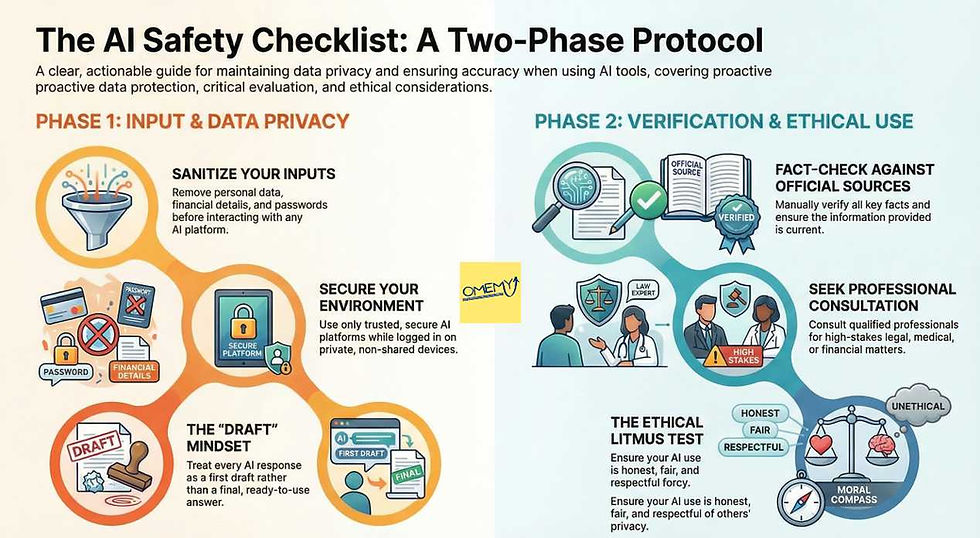
Your AI Safety Checklist
Print this. Stick it next to your desk. Read it before every AI session.
Before you type:
Am I about to share anyone's personal data? (If yes, remove it first)
Am I on a trusted, secure AI platform?
Have I logged in on a private device?
While using AI:
Am I treating AI outputs as a first draft, not a final answer?
Am I watching for red flags; overconfident answers, missing sources, or suspiciously perfect responses?
Am I avoiding sharing passwords, ID numbers or financial details?
Before using AI output in real life:
Have I verified key facts from an official source?
Have I checked that the information is current and up to date?
For legal, medical or financial matters; have I consulted a qualified professional?
Ethical check:
Am I using AI in a way that is honest and fair to others?
Am I respecting other people's privacy and data?
Would I be comfortable if others knew exactly how I used AI today?

AI is a remarkable tool. Like any tool, it works best when used with care, common sense, and a little bit of caution.
Sana eventually learned to use AI regularly for her tailoring business — for writing customer messages, planning her costs, and even researching fabric trends. She just learned to keep her customers' private details exactly where they belong: private.
And that made all the difference.


Really liked how this post kept things simple and didn’t try to sound smarter than it needed to. I could skim a bit, jump back, and still not feel lost, which is honestly rare. Halfway through I clicked around https://newimage.io/ out of curiosity, and it gave me the same kind of “clean and straightforward” feel without dumping a wall of text on you. The pacing here is nice too—short chunks, clear breaks, and it doesn’t make you hunt for the point. I also appreciate when pages don’t fight you while scrolling, like everything stays readable and you don’t lose your spot. On the site, the headings and spacing make the layout feel organized and easy to move through.